The Science of Harp Tone

An interactive guide to harmonica microphones, and then some

Where does that big, fat, gritty sound come from? It's physics. Don't let that scare you.

BlowsMeAway Productions · Interactive primer

Start here

A microphone is a translator

A microphone turns sound (tiny, fast changes in air pressure) into electricity that an amplifier can make bigger. The part that does the translating is the element. The housing it lives in is the shell. For harp players, both matter: the element sets the raw tone, and the shell decides how well you can cup it.

Before choosing either, answer the most important question of all: what do you want to sound like?

Acoustic

The mic stays in free air, on a stand or a rack, and the goal is a clean picture of what you'd hear standing next to the player. A good vocal mic like the Shure SM58 straight into the PA does the job.

"Acoustic" doesn't mean unamplified. It means the mic isn't in your hands.

The secret to good acoustic tone through a mic: learn to play quietly. Loudness changes enormously with distance, so harp played right against a mic set up for a singer at 6″ will hurt ears.

Amplified

The fat, distorted Chicago blues sound. The mic is almost always cupped in your hands, and the mic, the amp and your technique all become part of the instrument.

Most of this guide is about where that sound comes from, and every piece of it is physics you can play with below.

01 · Your harmonica makes bass

Beat notes

Each note is a wave of pressure, alternating between a push (speaker cone moving out, eardrum moving in) and a pull. Play two notes that are almost the same pitch and you hear a throb: the waves drift in and out of phase. In phase, their pushes add and the sum is twice as big. Out of phase, one wave's push meets the other's pull and they cancel to nothing.

The throb repeats exactly as many times per second as the two frequencies differ: |fA − fB|. Drag the sliders and watch.

From beats to bass: difference tones

Push the notes further apart and the throb speeds up: 5 times a second, 20, 40, 100. Somewhere past about 15–20 per second it stops sounding like a throb. Then comes the payoff: when you play two notes, a third, much lower note appears at |fA − fB|. That's the difference tone. Unamplified it's faint, but it's there if you listen for it. Through a good mic and amp? You absolutely hear it.

You can hear this bass note with nothing but a harmonica, if you listen for it. Your ear turns the fast swelling of the two notes into a low note. A cupped mic and an amp that's breaking up make it much stronger. They put a real bass note into the signal, and the speaker plays it. That's one big reason amplified harp sounds so much fatter than acoustic harp.

Try it: pick two holes and press Listen. Listen for the low note under the chord. Then press "Bass only" to hear that low note by itself. Its pitch is close to the difference between the two notes' frequencies, the rate at which they swell together (the shaded stretch in the lower picture). To be exact, your ear hears the low note that both notes are overtones of.

Chord tuning helps too. Many harps tune their chord notes slightly "just" (an exact 5:4 ratio for a major third, 4:3 for a fourth). Then the swell rate lands exactly on a note of the chord: for A harp 2 + 3 draw, an E two octaves below 2 draw. In equal temperament the swell rate comes out a little sharp (85.7 Hz instead of 82.4), but the note you hear stays close to that E, because your ear goes by the note both are overtones of. Tick the box to compare.

02 · Manufactured notes, the other direction

Harmonics

Difference tones add notes below what you're playing. Distortion also adds notes above it: harmonics (overtones) at 2×, 3×, 4×… the frequency of each note. The amp adds them when it's pushed past its clean range. But players control a lot of it: playing volume, and above all cupping, overdrive the mic, which sends a distorted signal that the amp amplifies (and more readily adds its own).

What shape the distortion takes decides which harmonics you get. Pick a type and push the drive.

Transfer curve: input → output

A pure tone in (dashed) and out

Harmonics added (1 = the note itself)

Tubes vs. transistors

The rule of thumb: tube amps make pleasing "even-order" harmonics and round "analog" clipping, while solid-state amps make harsh "odd-order" harmonics and square-wave clipping. The physics under the rule is mostly about shape:

  • Lopsided curves (a single tube gain stage treats push and pull differently) add even and odd harmonics.
  • Symmetric curves add only odd ones, whatever the device.
  • Soft knees make harmonics that fade quickly as they climb. Hard clipping squares the wave off, and its harmonics fade slowly (about like a square wave's, 1/n): strong 7th, 9th, 11th and beyond. That pile of high overtones, some of them out of key, is what sounds harsh.

Either kind of amp sounds fine played clean. Overdrive a solid-state amp, like any modern PA, and you usually get harshness. Tube amps have one more big advantage for harp, which you'll see in chapter 10: you can tame their feedback by swapping tubes.

Which harmonics are "musical"?

On a 220 Hz A: the 2nd harmonic (440) is an octave up, the 3rd (660) an octave and a fifth, the 4th two octaves, the 5th a major third above that. The low harmonics, odd or even, are all chord tones. From the 7th up, some (the 7th, 11th, 13th and 14th) fall between the notes of the scale, and the rest crowd ever closer together. So how fast the harmonics die away matters as much as odd vs. even.

03 · The seal

Cupping

Cupping is an art, a learned skill that is neither obvious nor easy. Done perfectly, at its extreme, no air you blow or draw can escape the seal, and then no sound comes out of the harp at all. So you always allow a slight leak. But until you can cup tightly enough to choke the harp off completely, you haven't perfected the technique.

With a good seal the air pressure is coupled straight to the mic's diaphragm, very differently from the free air mics are designed for. The result is a much stronger, distorted signal, with more lows and fewer highs. Here is why, in a simple acoustic model:

Pressure at the diaphragm vs. frequency (same playing; simplified model, so the dB values are illustrative)

What the model shows

Your hands, the harp and the mic form a small chamber of air, and any gap is a leak. Air can slosh out through a leak easily at low frequencies but not at high ones, so a leak drains the bass. Hands, harp cavity and leak together behave like a Helmholtz resonator (the physics of blowing across a bottle). The tighter the seal, the lower the leak's resonance, and the more bass pressure stays trapped on the diaphragm.

Leakage out of the front of the harp is the single most under-appreciated cause of thin tone. Sound pressure goes under the cover plates, through every open reed slot, and out the other holes. Tick the box above to see what it costs. You can practice sealing the front acoustically, before ever plugging in; it also deepens your "wah."

Why some mics respond to cupping more

Shape and size. If a mic is hard to seal, cupping simply does less.

Headroom: how much sound pressure a mic tolerates before it distorts. A mic with a lot of it won't break up. The Audix Fireball is specified to handle about 140 dB SPL: a brilliant piece of engineering, and a fine choice for acoustic playing or for feeding an amp-modeling pedal a clean signal. But it sounds nearly the same cupped or uncupped.

Where the element sits. Shells that hold the element further forward leave a smaller air cavity in front of it. In practice that makes cupping change the tone a little less (slight, but real).

04 · The shell

Mic shapes

In free air, a mic's shape does little to its tone. Cupped, the shape is everything, because it decides how easily and how well you can seal it. Hands differ, so one size definitely does not fit all.

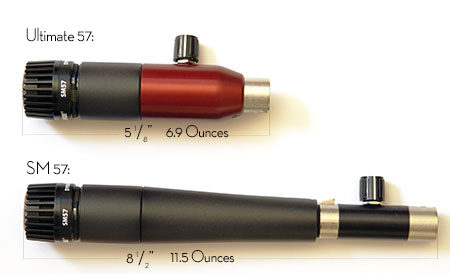
An Ultimate 57 next to a standard Shure SM57: the Ultimate is shorter and lighter
Stick mics like the SM57 cup easily for some players and cramp others' hands. A ball-end mic like the SM58 is hard for smaller hands. Their length also gives the cable leverage to pull down on the mic, another fatigue factor. The Ultimate series shortens and lightens them and adds a volume control.
Charlie Musselwhite's BlowsMeAway wood microphone
Bullets were cheap, popular mics from the late 1940s, and harp players soon found they cupped beautifully. The biggest in common use, Shure's current Green Bullet (520DX), suits large hands and is one of the heaviest mics around. Over a 3–4 hour show, that weight matters. Bumps on a JT30 or Blues Blaster make a tight cup uncomfortable. Smaller vintage shells (EV 630 and M23/43, Astatic JT30 and T3, Shure 707) are favorite project starting points. BlowsMeAway wood mics are comfortable thanks to a reasonable diameter and light weight.
The Bulletini in a cupped hand
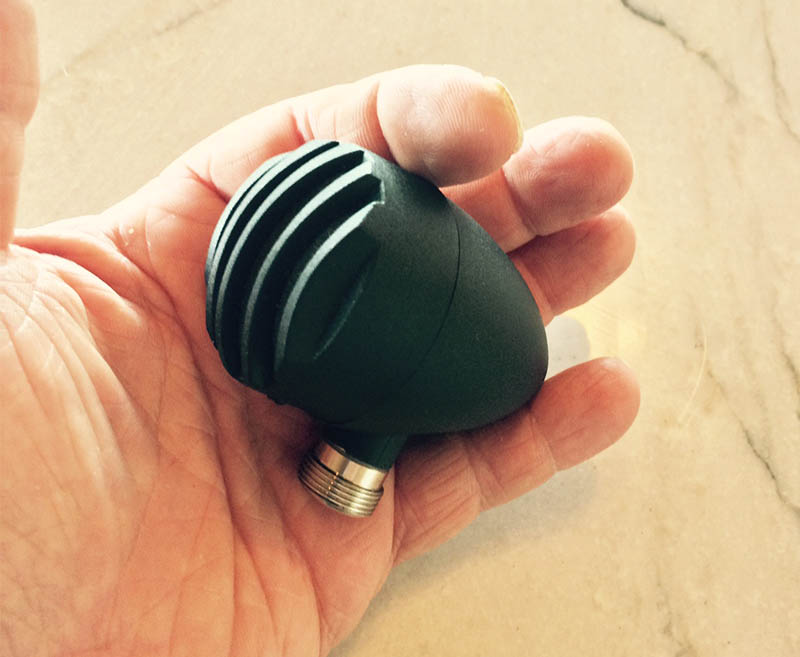
The Bulletini™ (2015) is even smaller in diameter, easy to cup, with an element built to roll off the highs and break up easily.

The space behind a dynamic element counts too

Crystal elements are sealed on the back. A dynamic element's bass response depends partly on the volume of air behind it. And if outside sound can get into that space, the mic becomes much more prone to feedback. Two classic culprits: removing a built-in volume control and leaving its mounting hole open, and putting a Shure CM or CR into a swivel-mount Astatic T3, whose big swivel hole never bothered the original crystal.

05 · Better is worse

Frequency response

No classic element was ever designed for harmonica; they were built for general use. Engineers call a mic "better" when it hears higher and lower (wider response), plays no favorites (flatter response), and has more headroom. For acoustic players, better really is better.

Here's the shocker: for amplified, ballsy blues tone, better is worse. Too much treble sounds harsh and can hurt ears. Vintage bullets are loved partly because their response typically falls off as low as about 5,000 Hz, even though young human ears hear up to about 20,000 Hz.

The curves are illustrative shapes, not measurements of any one model. The bars are the harmonics of a reed-like tone, and their height after the curve is what reaches the amp. The audio uses a simple synthesized reed tone through the same filter.

The same logic explains older and cheaper is often better. The original Shure Green Bullet and Astatic JT30 are prized because they give that old-school sound; they're what our harmonica heroes used. Why did the heroes choose them? Because they were cheap, even new. The JT30 was the entry-level mic in Astatic's line, at around $6.

In 2015 BlowsMeAway developed The Heumann Element™: a high-impedance dynamic element made specifically for harp, from a modern vocal element with mechanical and electrical modifications. It has big, fat tone with plenty of bass, and it's the element in the Bulletini.

06 · The element

How elements actually work

There are ribbon, condenser, electret, crystal and dynamic elements. Outside the studio, amplified players care about two: dynamic and crystal. They use completely different physics.

Dynamic: magnets and coils

A very thin diaphragm vibrates with the sound. In a moving-coil element it carries a coil of wire through a magnet's field. In Shure's Controlled Reluctance and Controlled Magnetic elements it drives a small iron armature through a pin, which changes the magnetic flux running through a fixed coil. Either way, changing magnetic flux through a coil (or a coil moving through a field) makes an alternating voltage (Faraday's law), and the output follows the diaphragm's speed.

A speaker is the same machine run backwards: current through the coil pushes against the magnet and moves the cone. A speaker can work as a mic, and a mic element as a (tiny, poor) speaker. Please don't test that with your good harp elements; the odds of damaging them are high.

Crystal: squeeze it, get a voltage

The diaphragm bends a crystal of Rochelle salt (or a man-made ceramic). Bending a piezoelectric crystal separates electric charge, so a voltage appears across it. The output follows how far it's bent. The igniter on a gas grill uses the same effect: a spring-loaded hammer snaps against a crystal, and the sudden squeeze makes thousands of volts, enough for a spark with no battery.

Electrically, a crystal element behaves like a voltage source behind a small capacitor. Keep that in mind; it's the key to chapter 07.

The Shure bullet elements, in order

Crystal

Tone: a slightly nasal honk

  • The great ones (Brush, Turner, Astatic, Shure; Shure and Astatic built them under Brush's patents) are about 70 years old and at the end of their lives. The Astatic MC-151 ran longer but is long out of production.
  • Rochelle salt is water-soluble. Humidity slowly softens it until it falls apart (a dead one often rattles when shaken), and heat and very dry air harm it too: Shure's own 1949 instructions warned that above 125 °F (a parked car) the crystal is permanently damaged. Drops, temperature extremes and even a hard draw with a tight cup can finish one off.
  • They fade gradually: lower output, or blow and draw responding unequally. "Untested" on eBay means assume dead.
  • Extremely high impedance: they need a very high-impedance input (chapter 07).
  • If your amp hums with an empty cable plugged in, expect hum with a crystal too. A dynamic element may reduce or mute it.
  • Modern crystals (Hohner Blues Blaster, Roadhouse JT30) are built for low cost, with much smaller diaphragms. Decent value, but no vintage honk.

Dynamic (incl. CR & CM)

Tone: more bottom end, fatter and richer

  • Practically bulletproof. Magnet-and-coil construction has lasted all these years, so they're cheaper and more plentiful.
  • Drop one (protected by a proper gasket in its shell) and it survives.
  • Lower impedance, so they stand up well to volume controls, pedals and splitters, though load any element heavily enough and you'll lose tone.
  • Black label CRs are the "Holy Grail." Vintage Electro-Voice and Turner dynamics are still played, though Greg prefers the Shure CR/CM sound.
  • Most modern dynamics are made too clean for amplified harp. Exceptions exist: a cupped SM57 breaks up very nicely.

The only way to really know the difference is to try good examples of each. To hear what players say about the Heumann Element, read the customer quotes.

Buying an element

If you like to gamble, buy on eBay. If not, buy from a reputable dealer who knows harp and knows elements. Even an element that "works" may be weak, and the only real test is to hook it to an amp and know how loud it's supposed to be.

Does the "ohm reading" matter?

Rule #1: never put an ohmmeter on a crystal; it can damage it, and since a crystal behaves like a capacitor, even a good one reads open, so you'd learn nothing anyway. On a dynamic element, a reading tells you the coil is intact and roughly its impedance class:

0 ΩShorted coil
≈ 50–100 ΩLow-impedance element
In betweenMedium impedance: rare, avoid (hard to find a matching transformer)
≈ 1,000 ΩHigh-impedance element
∞ (open)Broken coil

These are DC readings of the coil; an element's rated (AC) impedance is higher. The reading says nothing about tone: 1.1 kΩ is not better than 1.2 kΩ. And a good reading doesn't prove a corroded or squashed element works.

07 · Matching

Impedance, and why a crystal needs a 5 MΩ input

Impedance is resistance to an AC signal; your mic's signal is an alternating-current picture of the sound. Vintage bullets are usually high impedance and modern vocal mics usually low, though not always. Know what you have.

Every input you plug into puts a load across the mic. A low input impedance (a heavy load) is like dragging your foot on the brake. Here's what that does to a crystal, which electrically is a voltage source behind a small capacitor:

Volume control at the mic:

Signal reaching the amp vs. frequency

Model: a crystal element with an assumed capacitance of about 1 nF (Shure's 1949 spec for its 707A crystal: 900 pF, recommended load 1 to 5 MΩ; other elements vary, some several times more) driving the input resistance, plus about 30 pF per foot of cable. The input resistance and the element's capacitance form a high-pass filter, cutting below f = 1/(2πRC). A 50 kΩ input cuts everything below about 3 kHz, which is the whole harmonica, and literally sucks the tone right out of the best crystal. A volume control or anything else between mic and amp adds to the load. That's why BlowsMeAway's controls come in two values: the standard 250 kΩ for dynamic, CM and CR elements, and an extra-high-impedance 1 MΩ for crystals and ceramics. Try both above: the 250 kΩ that suits a dynamic would cost a crystal its bass. Dynamic elements have far lower impedance, so the same loads barely touch them.

Low vs. high impedance: what you need to know

1 Mics work best into an input whose impedance is well above their own. Players call getting this right matching: mic to amp, pedal or wireless transmitter.

2 An impedance matching transformer matches a low-Z mic to a high-Z input. A DI box goes the other way, high-Z to low-Z. Different names (mostly because of the connector genders), but both are matching transformers.

3 Low impedance came later, to allow much longer cables and to reject hum picked up along the way.

4 There is no inherent difference in tone or feedback between low and high impedance.

5 Low-impedance gear is almost always wired with XLR, the worldwide standard.

6 High-impedance gear uses many connectors, XLR included, but wired differently. A mono ¼″ plug, or the vintage screw-on connector (Switchcraft/Amphenol), almost always means high impedance.

Balanced (low-Z XLR) lines carry the signal on two wires in opposite polarity. Hum along the cable lands on both wires equally, and the input keeps only the difference, so the hum cancels while the mic's full signal comes through. That's how long cable runs stay quiet. Run a low-Z mic into a high-Z amp through an XLR-to-¼″ cable and you lose the transformer's voltage step-up and the hum cancellation: far less than half the output you should be getting. Hook it up properly: XLR-to-XLR into an impedance matching transformer.

08 · The squeal

Feedback

Feedback is the mic hearing the speaker and sending it back to be amplified again, around and around. It's a loop. Each trip around, the sound is multiplied by the mic's sensitivity, the amp's gain and volume, the speaker, and the trip back through the air. If that product, the loop gain, reaches 1 at any frequency where the returning sound arrives in step, the sound grows every lap until it screams.

Every mic-plus-amp system has a threshold. Turn it up far enough and it will feed back; that's a law of nature. You can't bring a knife to a gun fight. Drag the player around the stage, turn the mic, and work the knobs:

What actually matters

  1. Needing more volume than the system can make before feedback (the most common cause by far)
  2. Gain of the amplifier
  3. Sensitivity of the mic
  4. Distance from mic to speaker (amp, house speakers or monitors)
  5. Tone settings
  6. Player technique
  7. Directionality of the mic

Is your mic really "feedbacky"?

Usually not. A hotter mic is simply louder, and louder feeds back sooner. The only fair test is to set the amp so both mics are equally loud (try the level-match button above: "how loud you are" and "headroom before feedback" move together). Extremely sensitive mics really are more prone, but they're rare. Now and then one particular bullet just squeals sooner than its siblings. Sometimes that's holes in the shell; often the only cure is to use a different mic.

Directional (cardioid) mics reject sound from behind, but only in free air. Once you cup a mic, all bets are off. It's moving and pointing everywhere, and an open hand can act like a satellite dish that reflects sound in. Many players rest the mic's face against their chest between phrases. Stay a little back from the hairy edge.

Model: free-field inverse-square law (−6 dB per doubling of distance; real rooms reflect, so the drop is smaller) and a cardioid pickup pattern. Units are relative, not calibrated to a particular amp.

09 · Maybe you simply need a bigger amp

Watts, decibels & speakers

The decibel (dB) measures sound pressure level (SPL) on a logarithmic scale, which confuses everybody. Twice the power gets you only +3 dB, which is barely noticeable. To sound twice as loud (about +10 dB) you need ten times the power.

Say your 5 W amp makes 93 dB, freakishly loud in your living room. To be heard over a typical live band you need about 103 dB: +10 dB. A 15 W amp gets you less than +5 dB. You need 50 W. (Yes, everybody should play quieter. With your own band you have some control. At a jam you don't. Greg has checked figures like these with an SPL meter at live gigs; they're realistic.)

More speaker, too

As power goes up, speaker area should too. 50 W through a single 12″ usually sounds harsh and moves less air. More speakers given enough power move more air, and doubling the speakers at the same power gains a couple of dB (up to about 3, mostly in the bass, where they couple together). Build an amp:

Add a speaker:

Area here is πr² of each speaker's nominal size. The real cone is a bit smaller, but the comparison holds.

10 · For any given amount of power, gain is the most important variable

Gain & preamp tubes

Gain is not volume. Gain is the slope of the line from input to output. Picture a Mazda Miata with a 500 HP V8 and a gas pedal that only moves ½″. It's almost impossible to control in the corners. Give the same car 5″ of pedal travel and idle is still idle, and full throttle is still full throttle, but you can sneak up on the power smoothly, and you'll get around the track much faster.

Guitar amps (which most harp amps start out as) have far more gain than harp needs, because a guitar string is a much less touchy feedback device than a microphone. Lowering the gain doesn't add power. It adds pedal travel: feedback comes on gently instead of leaping out, so you can control it with technique and your volume control.

Loop gain as you turn the volume knob

Amplification factor (μ) of the 12A_7 family

A recipe that works

On a Fender Bassman or Blues Jr with three preamp tubes, replace the two 12AX7s nearest the amp's center (V2 and V3) with 12AU7s. That makes a significant difference. If it isn't enough, replace the outer one with a 12AT7 or 5751. That puts you right in the ballpark; then experiment and pick what you like. With three 12AX7s you likely can't get the normal channel past 2 before feedback, and an overdrive channel will be useless.

Solid-state amps can't easily be re-tubed, of course. For them, an anti-feedback pedal (such as the Lone Wolf Mojo Pad, the Squeal Killer, or Kinder's AFB+) can be very effective.

About the numbers

The figures are each tube's amplification factor (μ), the usual "gain factor" in tube charts. A real stage's gain is lower than μ and depends on the circuit, so treat the plot as a picture of the trend. The simulator simply treats V1–V3 as three stages in a row with gain proportional to μ, and the knob as an audio-taper pot. Real amps differ: in both the Blues Jr and the Bassman, V3 is the phase inverter rather than a gain stage. And low-μ tubes also have lower internal resistance, so a 12AU7's real stage gain is closer to a quarter of a 12AX7's than a fifth. That's why the recipe says "experiment."

μ (approx.)TubeEquivalents
10012AX7ECC83, 7025, ECC803, E83CC, 6681
705751
6012AT7ECC81, 6201, 6679
4512AY76072
4112AV75965
1912AU7ECC82, 5963, 5814, 6189

11 · Low gain isn't loud

How to be heard

A Blues Jr is ear-splitting in your living room, then can't be heard at the jam. So you turn it up until it feeds back and decide you have a feedback problem. You don't. You have an amplifier problem. An amp that doesn't feed back easily isn't necessarily loud.

Mic it

Mic the amp into the PA. That gives the audience much more volume, and small amps can have outstanding tone for less money. But if you or the band can't hear you, it's hard to play well. And putting much harp in the floor monitors is a feedback nightmare: it's best to hear your amp itself. At jams you may not get the option at all.

Line out

Same idea without the mic: a jack that sends the amp's sound at the right level for the PA. It's easier to connect, and nobody can kick the mic out of position. The good ones take their signal from the speaker circuit, so they carry the amp's real tone.

Other feedback tips

Avoid overdrive channels and pedals; they work by adding gain. Have the sound person take you out of the monitors, then sneak a little back in only if you need it. Change where you stand. Turn the treble or mids down. Try an anti-feedback pedal. If none of that works, you're asking more of the amp than it can deliver.

Get a volume control!

Rooms change between soundcheck and the show (the sound man included). A volume control at the mic kills feedback instantly, from where you stand, without diving toward the amp and making it worse. Feedback persists after you've backed off? That's the "Hey, it isn't me!" moment. A control also gives you wider dynamics, and lets you explore an amp turned up to 10 with the mic held below the threshold, which sounds different from the amp at 6 with the mic wide open. Charlie Musselwhite, Kim Wilson, Rick Estrin, Rod Piazza, Jason Ricci, Rob Paparozzi, Billy Branch, Curtis Salgado and Mark Hummel all use one, and not for lack of dynamic control. See the controls →

12 · Cutting the cord

What about wireless?

A transmitter goes with you and a receiver sits by the amp. None are completely transparent, and many tend to compress the sound somewhat, which you may or may not like. You generally get what you pay for.

  • Belt pack systems are often good and economical, but a cable still ties you to the mic, so you can't just set it down and walk away (a problem if you double on sax).
  • Plug-on transmitters make one self-contained unit. A "guitar bug" has a ¼″ plug and suits a high-Z mic with a ¼″ jack. Barrel-shaped XLR transmitters, made for vocal mics, can work fine with a high-Z mic too, provided its XLR is wired "pin 2 hot." BlowsMeAway's adapters do exactly that.
  • Any system must be set up properly to get close to the sound of a cable. BlowsMeAway sets up wireless systems for harp for your mic and amp.
  • In the US: wireless mics in the 700 MHz band had to stop operating in June 2010, and those in most of the 600 MHz band (617–652 and 663–698 MHz) in July 2020, to clear those frequencies for other services. If you're buying used, check the frequency.

Choosing a mic builder

Builders are not all created equal

  1. Easy to communicate with? If emails and calls go unanswered for more than a day or two, it's the wrong builder.
  2. Reputation? Search online and ask around. Unhappy customers may not post publicly, but they'll answer a private email.
  3. Who are their customers? Pros willing to put their name on a builder is a strong recommendation.
  4. Can they really play? A builder who performs understands tone, compatibility, reliability and feedback from the stage, and there'll be videos or recordings to prove it.

Only one thing matters

Your satisfaction. You can't know enough when you buy your first mic; only when you buy your second can you hear how it differs. The more you try, the better your technique and the more places you play, the wiser you'll get. Meanwhile you can avoid wasting a lot of money by choosing your sources wisely and trusting their advice.

Questions? Email Greg any time at greg@blowsmeaway.com. That's what he's here for.

Adapted from "All About Harmonica Microphones, and Then Some" by Greg Heumann, © 2010–2016 BlowsMeAway Productions.