|
I normally gig through one of the most coveted harp amps there is, a Sonny Jr. 4x10. But I wanted a smaller practice amp. I'm pretty handy with tools and a soldering iron, so I considered building a Fender Tweed Champ from a kit. It was going to set me back about $400 plus a lot of time, so I decided first to check with Sonny Jr. himself - the guy knows more about amps for harp than anyone else I've ever met. He said "Save your money and get yourself a Kalamazoo Model 2 off of eBay. Best little harp amp I ever heard."
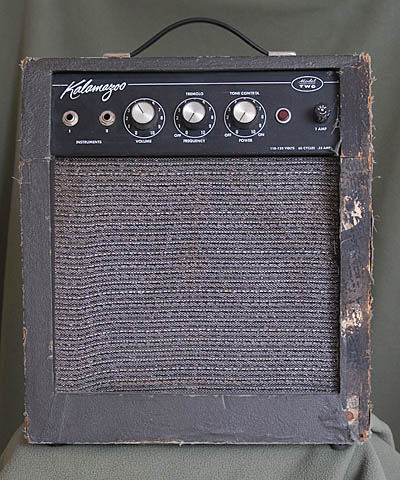
So I took his advice, and bought the amp you see pictured to the right. It has a typical Kalamazoo "patina". Fixed it up and you know what? Sonny Jr. was right!
Listen!
Here's a short MP3 of a Kalamazoo all by itself.
I am NOT a recording engineer - this was done in my living room through a TASCAM USB Audio interface, straight into my computer. I did no post-processing on the file. I played through one of my custom mics with a Shure Controlled Magnetic element. I used an Audix Fireball as the recording mic because it has very flat frequency response and very high headroom. The distortion you hear is an accurate representation of what you can expect from a 'Zoo.
Here's a newer, longer sample, with some accompaniment. That's a Jamie Abersold CD on my stereo, and me blowin' to it off the top of my head. I used my new Edirol R-09 and recorded straight to MP3. No effects. My goal with what I played was to showcase the amp through a range of playing styles, not to play something cohesive. You'll hear single-note, chords and octaves, played both open and tightly cupped through a Shure Controlled Magnetic element in one of my wood mic shells.
|
This amp is sold but I may have more like it. Check with me!
|
This amp is sold but I may have more like it. Check with me!
|
More about the amps...
Kalamazoo amps were made by the Chicago Musical Instruments, or CMI (Gibson's parent company during the 60s) from 1965 to 1967. They were marketed as inexpensive guitar practice amps. I can tell you, they're not very exciting with a guitar plugged into them. But as harp amps, they ROCK! They break up easily in response to just about any good harp mic and have a wonderful, dirty, gritty -- but not harsh -- tone.
And they have a really cool tremelo effect. Place one of these on each side of the stage and set the tremelos to different frequencies and you get a magical "Leslie" effect that throws the sound all over the place! But I digress.....
The last of the Model 2's received a face lift and look like the one shown at left. I refer to these as the "brown face" amps. The circuit is the same as the earlier amps, though - they sound just as good.
For much more information about Kalamazoo amps, see Miles O'Neal's fine web page.
|
|
Buyer Beware
I have now bought nearly 50 'Zoo's on eBay. I have reconditioned and sold them to as many happy customers. I'm sure that gives me more experience than anyone else on the planet, but I can't prove it, so I won't claim it as gospel.
Of course, the eBay sellers always say it sounds just fine, but when I get them, there are almost always problems. I have had amps with bad tubes, blown speakers, blown transformers, bad capacitors, shorted resistors, bad switches and pots, cabinets being held together by only a few strings of tolex, broken baffle boards, you name it. Some of them actually did make some noise when I first turned them on, but not a single one was "right."
I have identified a design weakness that leads to an expensive failure, and a correction for it. The two input jacks are connected to the same solder lug on the preamp tube socket by resistors, wired directly from the jacks to the lug. When you plug your cable into the amp, the face of the chassis flexes, putting stress on this lug. (Resistors have relatively stiff wires.) Ultimately the lug will break leaving you with nothing but hum. Replacing a tube socket is a relatively expensive repair - it takes me well over an hour to do, and then there's parts and shipping.... The amp you buy on eBay may be ready to fail and may well do so in shipping.
All amps I work on receive a mod to secure the chassis face to the cabinet, eliminating this common cause of failure.
The lesson here is that unless you know what one is supposed to sound like, and/or are willing to do the work to make a bad one good, you're at the risk of getting screwed if you try to buy one yourself.
|
Avoid the model shown above at all costs! For a short while before ceasing production, CMI produced this "Kalamazoo Model 2". It is 100% Solid State! No tubes. No Good. The pic above shows an amp missing its middle knob - it was laid out exactly like the "real" Model 2, but with the silver face plate.
|
|

This amp is not for sale
|
What can you expect?
I had to build an entirely new cabinet for the one you see at left. I covered it with lizard skin and a rainbow-sequined grill cloth. I call it my "Lounge Lizard" amplifier.
Building a new cabinet from scratch is a lot of work - so I generally try to avoid it as it is difficult to justify the labor in terms of a resale price. Ordinarily I just try to make them structurally sound, but more importantly I make them electrically safe, mechanically sound and functionally correct.
I always convert the original 2-wire plug into a properly grounded 3-wire circuit to reduce the risk of electric shock. And I always add a screw to secure the face of the chassis to the cabinet (see "Buyer beware" above.) Then I replace components as needed - every amp is a little different. But they have one thing in common - they all sound great!
|
|
How Much?
Prices range from about $259 (for a beat up Model 1) to $349 (for a really clean Model 2.) Remember, even the "beat up" ones are mechanically sound and work fine - they just have more "character" or "patina" than the cleaner ones..... Shipping in the continental U.S. runs about $35. (I do not sell these internationally, sorry. The cost to ship is astronomical.) If you buy an amp from me, or pay me to recondition yours, I guarantee it for 90 days. Prices are going up as these amps become harder to find and better known. I constantly watch the prices of these amps on eBay and they have been climbing steadily, to the point where I have had to raise my prices too, or I can't get even lousy ones to fix. (I feel sorry for the folks who pay top dollar for one of these amps and don't know when they get it that it isn't operating as well as it could.)
I rarely have inventory of amps. Every amp I can get my hands on sells immediately to someone on my waiting list when it comes off my bench. If you would like me to add you to the list, click here to contact me.
|
|
Upgrades
These amps are great "straight out of the box". However there are some upgrades I've found to be worthwhile.
- Speaker Phase Switch - $49.
Speaker phase refers to the direction the speaker cone travels in relation to the microphone diapragm or another speaker. In relation to the micropone, changing the phase affects the characteristics of feedback, and can be used to reduce it. In relation to other speakers, such as when using the amp with another, speakers "in phase" produce a localized sound image and bass response is accentuated. When speakers are out of phase, bass response is reduced and the sound appears to come from nowhere in particular. If your speakers are in phase and you turn one amp around (such as to use as a stage monitor) they will then be out of phase and bass response again can be reduced. The speaker phase switch simply lets you choose whatever sounds best.
- Speaker Upgrades
I have found the Jensen C10R to be an economical upgrade, but I can install the speaker of your choice. I can supply one or you can. Price varies with the speaker, of course, but if you're already buying an amp from me I will not charge any additional labor to install a speaker.
- Hammond power transformer - $99.
The Hammond transformer provides cleaner power with more current available than the stock transformer. It gives the amp a more grownup or "Fender Champ" type sound - a little less crunch, smoother sound, better bass response.
|
|
|
|
|